

Last Updated: October 30, 2026
Quick Summary
Private and secure rare book purchasing means confirming the seller’s legal identity, getting the return policy and clear title in writing, and paying by a method with a dispute path. Insure shipments to the full purchase price and keep a dated transaction file.
- The global second-hand book market is projected to grow from $29.6 billion in 2026 to $45.1 billion by 2033.
- Match the payment account name to the seller’s business name, and stop if they differ.
- Ask the seller to confirm clear title in writing before you pay.
- Mary Baker Eddy’s Science & Health went through 432 editions, with the 1875 first edition carrying unique details.
- Open high-value packages on camera from sealed package to opened book.
Table of Contents
- Why Discretion and Security Matter in Rare Book Purchasing
- Rare Book Seller Questions to Ask Before You Pay
- Rare Book Authentication: Confirming a First Edition Is Genuine
- Using a Rare Book Condition Guide to Judge Value
- Secure Payment and Rare Book Shipping and Packaging
- Building Your Request List for Out-of-Print Christian Science Titles
- Frequently Asked Questions
Why Discretion and Security Matter in Rare Book Purchasing
Private and secure rare book purchasing starts with one uncomfortable fact: the market is growing fast, and so is the number of people who know what your shelf is worth. According to Persistence Market Research’s second-hand books market forecast, the global second-hand book market is projected to grow from $29.6 billion in 2026 to $45.1 billion by 2033, a 6.2% compound annual growth rate.
That growth pulls in casual buyers and careful ones alike. At Healing Unlimited, we work mostly with the careful ones: students of Christian Science hunting first editions of Mary Baker Eddy’s works, practitioners building a reference shelf, and researchers who need primary sources.
Discretion matters for three reasons:
- Value attracts attention. A signed copy or first printing is worth real money, and that fact travels.
- Your collection is private information. What you own, and where you keep it, should not be public.
- Bad actors follow demand. The Wall Street Journal’s reporting on bulk rare-book buying describes mystery buyers placing large orders with used-book sellers, suspected of sourcing material to train AI models. Anonymous bulk demand is exactly the kind of noise that hides a stolen volume.
Rare Book Seller Questions to Ask Before You Pay
Any seller can talk about a book. Fewer can answer a paper trail. Treat seller due diligence as a written checklist, not a one-time conversation. You can also read about the acquisition of Rare Book Company and its interim catalog.
Step 1: Confirm who you are actually dealing with
Before you discuss price, establish the legal identity behind the listing.
- Get the legal business name and a physical address. A registered business name, street address, and callable phone number are the baseline. A PO box alone is not disqualifying, but pair it with a verifiable business identity.
- Check the business registration. Confirm the name on the listing matches the business’s official registration record.
- Match the payment name to the business name. If the invoice and payment account names differ, stop and ask why in writing.
Step 2: Read the reputation, not just the star rating
A five-star average tells you almost nothing about how a seller behaves when a book arrives damaged or misdescribed.
- Read the negative and neutral reviews first. Look for how the seller responded to a dispute.
- Check how long the seller has been active on each marketplace.
- Search the seller’s name alongside “return,” “refund,” and “misdescribed” to surface complaints that never made it into a review.
Step 3: Pin down the return policy in writing
A return policy you cannot quote is a return policy you do not have.
- Get the return window in days, the condition required to qualify, and who pays return shipping.
- Confirm the policy covers condition disputes, not just shipping damage. Many marketplace policies default to “as described,” putting the burden on you to prove a mismatch.
- Save the policy text as a screenshot or PDF at purchase, because listings and policies change.
Step 4: Build the transaction record before you pay
Ask the seller to put the following in the invoice or a written confirmation:
- Full bibliographic description, author, title, publisher, place, date, edition, printing, and issue points.
- Condition grade and every disclosed defect, using a stated grading scale, not adjectives.
- Provenance summary, prior owners, auction records, bookplates, or letters, with copies where available.
- Return terms, window, condition requirements, and who pays return shipping.
- Shipping method, carrier, insurance amount, and signature requirement.
- A statement that the seller has clear title and that the book is not subject to a pending claim.
If a seller resists putting any of this in writing, walk away. There is always another copy.
Step 5: Run stolen-book and ownership checks
Stolen merchandise is a risk buyers should consider. A rare book can change hands several times before anyone reports it missing.
- Search the title, edition, and distinguishing marks against stolen-book registries and dealer networks. Stolen-book reports from dealer networks and booksellers’ associations are worth checking directly.
- Ask the seller to confirm in writing that the book is not subject to a pending claim and that they have clear title.
- Request the prior sale record if the seller bought it at auction, auction house, lot number, and date.
If a seller cannot or will not confirm clear title in writing, treat that as a hard stop regardless of how good the price looks.
Before you pay, work through these seller due diligence steps and confirm each item in writing.
| Step | What to do | Key point |
|---|---|---|
| 1 | Confirm legal business name and physical address | Match payment name to business name |
| 2 | Read negative and neutral reviews first | Check how seller handled disputes |
| 3 | Pin down return policy in writing | Get return window in days and who pays shipping |
| 4 | Build the transaction record before paying | Full bibliographic description, condition, provenance, return terms |
| 5 | Run stolen-book and ownership checks | Ask for written confirmation of clear title |
Rare Book Authentication: Confirming a First Edition Is Genuine
Rare book authentication confirms that a physical volume is the edition, printing, and issue it claims to be. It combines physical inspection, bibliographic reference, and provenance review.
Start with the details that reprints get wrong:
- Title page date and publisher imprint. Compare both against a bibliography.
- Printing statements. “First edition” and “first printing” are not the same claim.
- Paper, binding, and type. Reprints often look too clean and too uniform.
A specific example helps. You can see the 1875 first edition listing to study those markers. The same applies to early periodicals: a genuine first and second volume of the Christian Science Journal bound in one book shows wear patterns and printing a modern reprint cannot copy.
Watch out: a seller who calls something a “first edition” without naming the bibliographic source is guessing, and so are you if you accept it.
Using a Rare Book Condition Guide to Judge Value
A rare book condition guide is a grading scale that describes a book’s physical state, from fine to poor, so buyers and sellers can agree on what they are looking at.
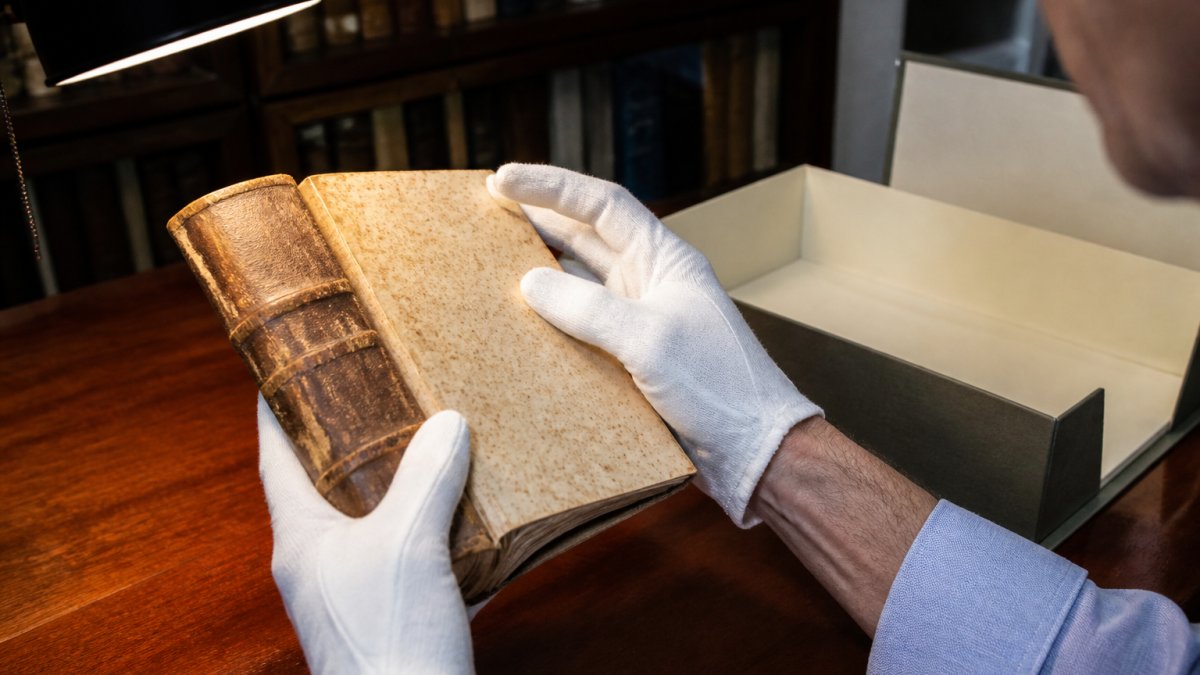
Check these points in order:
- Spine and hinges. Cracked hinges drop a grade fast.
- Foxing and staining. Brown spots are common but cost value.
- Missing leaves or plates. Always ask for a collation check.
Ask the seller to grade in writing and to note every defect. A listing that describes a specific set’s condition and remaining stock tells you more than a page of praise. See the Science and Health third edition listing for an example.
Secure Payment and Rare Book Shipping and Packaging
Secure payment for rare books means using a method with a written record and a dispute path. Credit cards and established escrow services can give you both. Payment methods such as wire transfers generally offer fewer dispute options once funds leave your account.
Choose a payment method with a dispute path
- Credit cards can offer chargeback rights, giving you a formal process to dispute a charge for goods not delivered as described. Check your card issuer’s dispute terms and inspect purchases promptly.
- Established escrow services hold funds until you confirm receipt and condition. Use one for anything expensive, and confirm the service is legitimate before sending funds.
- Documented invoices should accompany every payment. The invoice is the contract.
Build the transaction file
Keep a single folder, digital or physical, containing:
- The listing as it appeared at purchase (screenshot with date).
- The invoice and any written condition or provenance confirmations.
- All messages with the seller.
- Payment confirmation and the payment method’s dispute terms.
- Shipping tracking, insurance receipt, and delivery confirmation.
- Photos of the package before opening and of the book as received.
Open high-value packages on camera. A continuous video from sealed package to opened book is the strongest evidence you can have if condition is disputed later.
Ship it insured, tracked, and signed for
Rare book shipping and packaging deserves its own attention because most damage happens in transit, not on the shelf.
- Require tracked, insured shipping with signature on delivery for anything you would not want to lose.
- Insure to the full purchase price, not the carrier’s default declared value.
- Confirm the carrier’s claims process before shipping, some exclude certain packaging methods, and a claim denied for packaging is unrecoverable.
Proper packing means:
- A clamshell slipcase or a rigid box, not a padded envelope.
- Acid-free tissue around the boards and spine.
- Padding on all six sides, with the book unable to shift.
Handle a misrepresented book correctly
If the book arrives and does not match the written description, act in order:
- Photograph everything, packaging, book, and the specific defect or mismatch, before you alter anything.
- Notify the seller in writing within the return window, citing the specific description term not met.
- Request a return authorization and refund in writing, including who pays return shipping.
- If the seller refuses, escalate to the marketplace or payment provider with your transaction file. A chargeback or escrow dispute is far stronger with dated photos and the original listing.
- For high-value disputes, consider a written appraisal from an independent specialist to document the gap.
Protect your personal data during the transaction
Your buying history is sensitive. Treat it that way.
- Use a dedicated email address for purchases.
- Give a business address or package locker for delivery when you can.
- Ask the seller how they store customer records.
Small habits, applied every time, keep a private collection private, and keep a disputed purchase recoverable.
Building Your Request List for Out-of-Print Christian Science Titles
Out-of-print books rarely appear on demand, so the buyers who succeed are the ones who plan. A request list turns scattered searching into a system.
Build yours in four steps:
- List the titles you actually need, with edition and printing if it matters.
- Note acceptable condition grades so you do not pass on a good copy.
- Set a ceiling for each title and stick to it.
- Record where you have already asked, so you do not duplicate requests.
A bibliography helps more than a general search engine here, since a dedicated reference lists titles and editions in one place. A Christian Science library bibliography can support that work.
Then use a want-list service. Healing Unlimited offers a personalized want list service for locating specific titles.
Frequently Asked Questions
How can I buy rare books safely online?
Start with the seller, not the listing. Ask for the publisher, printing statement, and copyright page details, plus clear photos of the binding, spine, and any inscriptions. Pay with a method that offers dispute protection rather than a wire transfer or gift card, and keep the listing, photos, and correspondence in one folder. When the book arrives, inspect it before the return window closes and document its condition with your own photos. Requesting tracked, insured shipping with archival packing materials adds another layer of protection.
How do I verify that a rare book is an authentic first edition?
Rare book authentication depends on the details printed inside the book, not the cover. Check the title page for the original publisher and the copyright page for the printing statement, since later printings often reuse the same plates. Confirm the edition points that bibliographies list for that title, such as a specific date, a publisher’s imprint, or a misprint that was corrected later. A signed copy needs handwriting verification as well. Ask the seller to photograph the title page, copyright page, and signature so you can compare them against a published bibliography before paying.
What should I ask a seller before buying an out-of-print book?
Ask for the exact publisher and printing, whether the dust jacket is present, and whether any pages, plates, or endpapers are missing or repaired. Request photos of the spine, hinges, corners, and any foxing or water stains. Ask where the book came from and whether the seller can share provenance details. Confirm the return window, who pays return shipping, and how the book will be packed. A seller who answers these rare book seller questions with specifics and photos is usually a safer counterparty than one who answers vaguely.
How should rare books be shipped to prevent damage?
Rare book shipping and packaging should keep the book from moving inside the box. Wrap the book in acid-free tissue or paper, then bubble wrap, and place it in a rigid box with padding on all six sides. Ship it separately from other items, use a tracked and insured service, and ask the seller to note the insurance value on the label. When the package arrives, open it on a clean surface and photograph the box and book before unwrapping fully, so any damage claim is documented from the start.
The hardest part of collecting is not finding books. It is finding them without giving away your privacy, your money, or your trust. Healing Unlimited serves students of Christian Science with rare first editions and out-of-print volumes, a personalized want list for hard-to-find titles, and a free library of articles and study aids to support your work. Get started with Healing Unlimited and build a collection you can verify, protect, and study with confidence.
